
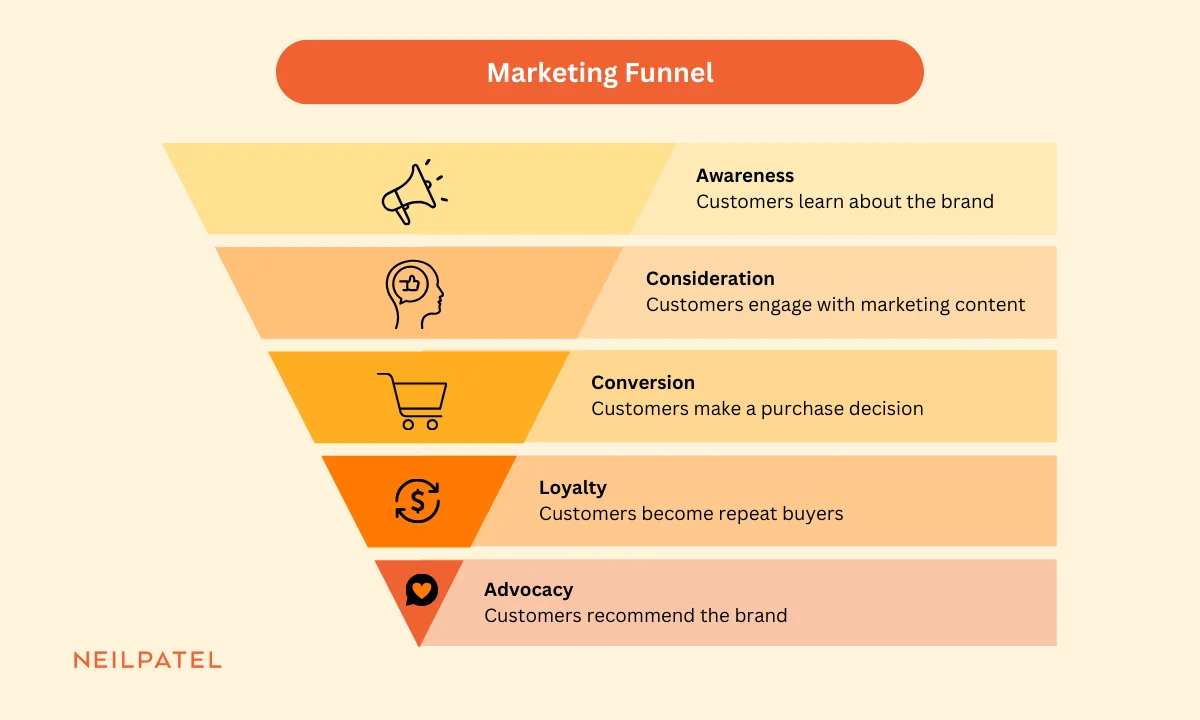
If you are a new company, the zero moment of truth dictates that you need more high-funnel awareness driving content from the get-go than if you were more established. This top of funnel content often receives the least emphasis while it’s of the highest importance – it’s how new people get introduced to your brand. Dedicate more budget than you think you should to making sure it’s reaching more than enough high-quality likely-to-convert prospects. And don’t rely on strangers with no context to do the converting: separate prospecting and retargeting campaigns to make sure you’re identifying buying intent and capitalizing on warm leads.
The Case For Active Reach At The Top Of The Funnel
Most advice about funnels assumes that you already have an audience to send through them.
But you don’t.
So the top of your funnel isn’t just the widest part. It’s the whole game right now.
Passive strategies like blog content and organic social can work and we’ll add them later. But they work slowly and tell you very little about your audience while they’re working. Active reach strategies generate data immediately. Every impression, every click, every bounce gives you something to act on. That’s what makes them the right starting point for new business contexts where both budget tolerance and learning speed are at a premium.
The goal at this stage isn’t conversions. It’s qualifying your audience – by showing them something and watching who reacts. It’s like drawing a fish to the bait, and then watching to see what kind of fish it is. Every user who engages gets added to your retargeting pool. Every user who doesn’t tells you something about your targeting.
Ad Formats That Force A Decision
Passive placements like banner ads in a sidebar don’t give you enough bang for your buck. You want ads that at least make the user say ‘yes’ or ‘no’ about whether they’re interested in your offer. Full-screen interstitial ads are the best possible way to do this. They present your ad to the user as they naturally pause during a visit to a new page or in between levels of a game. The user can’t just keep scrolling past. They make a decision to engage with the content or to tap that little x in the corner and close the ad.
If they engage, great. If they don’t, also fine – the ad served its purpose in reacquainting or introducing the user to your brand. This is what really separates the best top-of-funnel tactics from those that just waste your budget.
Splitting Your Budget Between Broad Reach And Targeted Segments
One of the most typical mistakes new businesses tend to make is overspending or underspending in the first place. Overspend too broadly and your budget on unqualified traffic is on fire. Underspend too narrowly and you don’t amass enough data to know if your assumptions were even correct in the first place.
As a starting framework, a 70/30 split works well enough. Roughly 70% of your T-o-F budget should go to the broad type campaigns that target and wide demographic spectrum. The other 30% should be aimed at very niche segments you happen to hold assumptions about – a job title, an interest category, a behavioral signal. With the 30%, you’re not endeavoring to win it. You’re just testing whether your assumptions are true.
2-3 weeks in, you look at the data. It will tell you which segments showed the highest CTR and the lowest bounce rate. You then reallocate more of your budget to those segments. This is how you find your most profitable audience without having to guess.
Getting The Landing Page Ready Before You Run Anything
Delivering campaigns to a broad audience using dynamic ads can bring in a lot of unqualified visitors. Because the ad itself was so broad, almost everything they see on the landing page will be a disconnect from the reason they clicked. That’s not necessarily a failure, you were just testing what sort of person is interested in your proposition. You now have data on actual visits in hand, and those visits will likely be cheap. Most people in this situation panic. They say the ad isn’t working, or the product doesn’t have a market, and they turn it off too early. If the people who visit are cheap, let the ad run until you have enough data to make a decision. The problem probably isn’t the ad itself, but the landing page. Which means improving the landing page will be far cheaper than starting over.
Managing Frequency Before Ad Fatigue Sets In
Aggressively trying to reach the top of the funnel can easily lead to overexposure. If users are repeatedly served the same ad format and fail to engage, their engagement levels will decrease and they may develop negative feelings about your brand. This is a valid concern when using high-impact formats.
It’s important to establish frequency caps from the get-go. For full-screen formats, it’s advisable to cap exposure at three to four times per user within a seven-day period. Exceeding this limit doesn’t create awareness, it creates irritation. Rotate your creative every two weeks at a minimum, and monitor your CTR trend. If it starts to decline and you haven’t modified your targeting or budget, it’s not a targeting issue but rather ad fatigue.
Formats that lead the top of the funnel must force attention, budget split must generate a signal, and the landing page must convert what you catch. That’s how you create lift when you’re starting from scratch.